The problem
Non-profit lottery campaigns are structurally different from standard DTC campaigns. You have a hard deadline — the draw date — a specific dollar target that must be hit, and a geographic constraint: only residents of the province where the lottery is licensed can legally purchase. Miss the deadline or miss the target and the fundraising goal fails entirely.
For this campaign, the brief was to hit a combined $350K+ in ticket sales across Ontario, Alberta, and British Columbia within four weeks. The previous campaign infrastructure had slow activation timelines — cross-team approval and production processes were adding days to what should have been hours. By the time campaigns went live, usable campaign days were already being lost.
The two problems were connected: slow activation meant less time to optimize, which meant higher CPAs and harder targets to hit. Speed and performance had to be solved together.
The strategy
Cutting activation time by 50%
We audited the end-to-end campaign activation workflow — from brief to live ads — and identified the steps adding delay without adding value. Creative approvals, asset handoffs, and platform setup were streamlined into a pre-built sprint template: standard creative formats pre-approved, audience lists pre-built, campaign structures templated and ready to populate. When the campaign window opened, we were live within hours rather than days.
Activation speed isn't just an operational metric in a time-sensitive campaign — it directly compounds ROI. An extra 3 days of live time at the end of a 28-day sprint is an 11% increase in available optimization cycles. That translates directly to CPA and ticket sales.
AI-powered audience building for high-intent buyers
Lottery ticket buyers are a specific audience: they need to be in-province (legally required), they need to be aware of charitable giving as a value, and they need to be in an active consideration mindset rather than purely entertainment-driven. We used AI-powered audience tools to build lookalike and custom audience segments from historical buyer data and high-intent behavioral signals — giving Meta and Google's algorithms a strong seed to work from rather than cold prospecting from scratch.
Provincial phasing and daily budget reallocation
Ontario, Alberta, and British Columbia have different audience sizes, different CPA curves, and different conversion rate profiles. Rather than splitting budget evenly on day one, we launched simultaneously across all three and reallocated daily based on which province was delivering lowest CPA and most remaining headroom. Budget followed performance on a 24-hour cycle throughout the sprint.
Creative built for urgency without desperation
Charitable lottery creative has a specific tonal challenge: you need urgency (deadline, limited tickets) without sounding like high-pressure sales. The winning creative framing was cause-first — lead with the charitable mission the lottery funds, then the prize, then the deadline. This sequencing produced higher CTR and lower CPM than prize-first messaging in testing, because the charitable cause differentiates the lottery from commercial gambling and creates a genuine reason to buy beyond the prize.
Key insight
In time-constrained campaigns, activation speed is a performance lever, not just an operational metric. Every day a campaign isn't live is a day the algorithm can't learn. Every day the algorithm is learning is a day CPA is still falling. A campaign that launches 3 days late on a 28-day window has effectively lost 11% of its optimization budget before the first impression served.
Results
- $350K+ jackpot target achieved within the 4-week campaign window
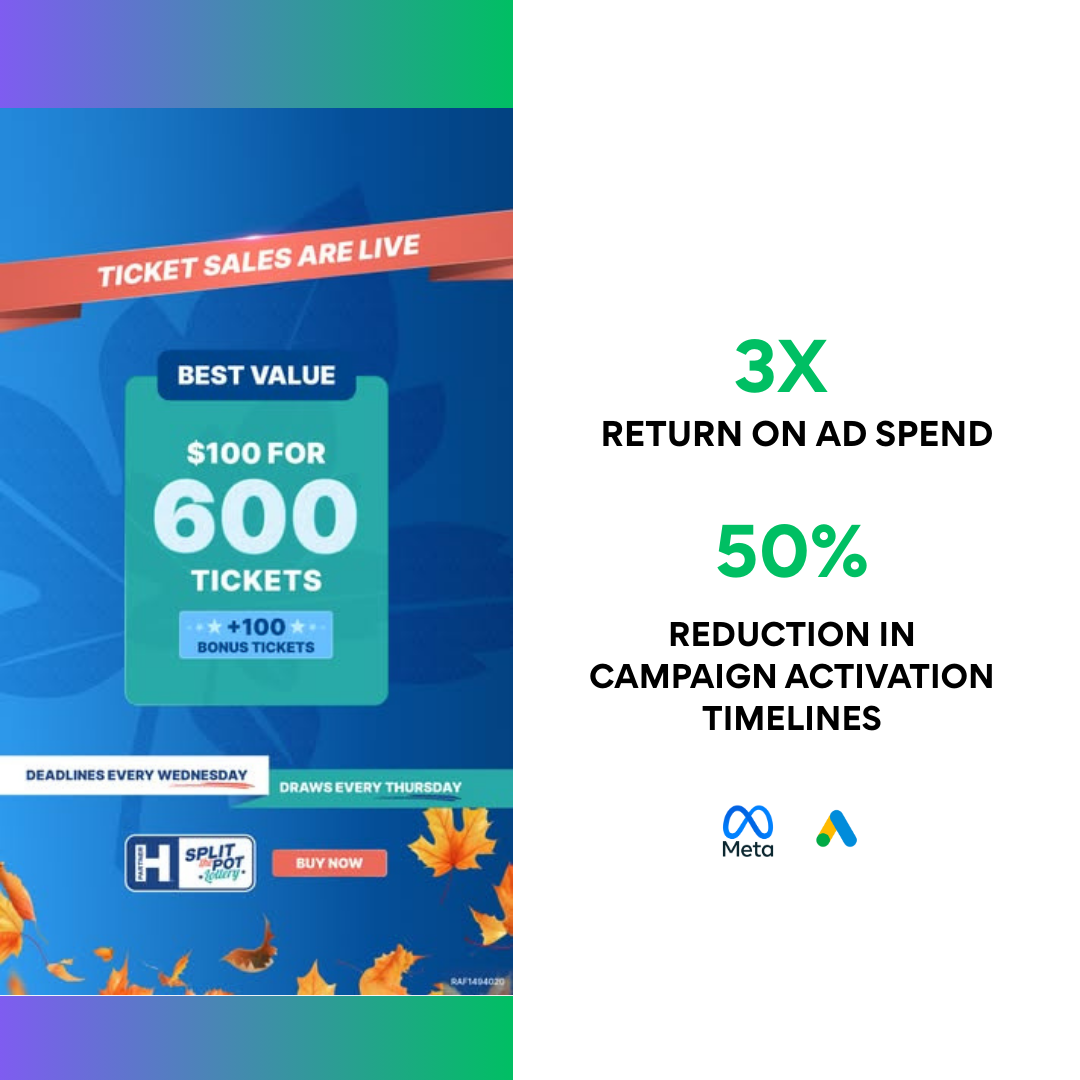
- 3x return on ad spend across Meta and Google combined
- 50% reduction in campaign activation timeline — from multi-day setup to same-day launch
- Multi-province campaign successfully executed across Ontario, Alberta, and British Columbia with province-level budget optimization
- Charitable cause-first creative outperformed prize-first messaging on CTR and CPM in A/B testing
Platforms
Meta
Google Ads
Frequently asked questions
How do you run a successful time-sensitive paid advertising campaign?
Three things matter most: activation speed, daily optimization cadence, and pre-built creative. Slow activation wastes the early days when CPAs tend to be higher and optimization potential is greatest. Build campaign structures, audience lists, and creative in advance so you go live immediately when the window opens. Then run daily budget reallocation — in a 4-week sprint, weekly optimization is too slow.
What digital advertising platforms work best for non-profit campaigns?
Meta and Google are the highest-volume options for non-profit campaigns with geographic and demographic constraints. Meta excels at emotional connection with cause-based creative. Google captures high-intent search traffic from people actively looking to give. Both support province or state-level geographic targeting with strong precision.
How do you target lottery ticket buyers with digital ads?
Start with geographic containment — target only within the licensed jurisdiction. Layer behavioral and interest signals associated with charitable giving and community involvement. Lookalike audiences built from past buyers typically outperform cold interest-based targeting. AI-powered audience tools can accelerate this by scoring broad audience pools against buyer-behavior patterns before spend begins.
What creative approach works best for charitable lottery advertising?
Lead with the cause, not the prize. Advertising that leads with what the money funds outperforms prize-first messaging on CTR and CPM. The cause differentiates the product from commercial gambling and gives buyers a reason beyond winning to participate. Urgency (deadline, limited tickets) should appear in the ad but not dominate the first frame.
Working on a time-sensitive campaign?
We know how to build for speed without sacrificing performance. Let's talk.
Get a free audit