The problem
This US-based women's lifestyle brand sells accessories and home goods in a category where the default competitive move is to cut price. The product quality is genuinely better — better materials, unique designs, more thoughtful product details — but paid social doesn't give you three sentences to explain that. You have one scroll stop.
When we came on board, the brand was running Meta at a 3x ROAS baseline. Solid, but plateauing. The catalog had grown across multiple product sub-categories — each with a different audience, a different purchase intent, and a different creative requirement — and they were all being served from a single campaign structure. Segments were competing against each other for budget and audience overlap was causing internal cannibalization.
Pinterest was entirely untested. The brand had assumed it was for brand awareness, not performance. That assumption was wrong.
The strategy
Step 1 — Audience architecture before ad spend
Before touching the campaigns, we built detailed buyer personas for each product sub-category. Not demographic profiles — behavioral profiles. Who actually buys versus who saves to a wishlist. Which audiences convert in 24 hours versus which need a 7-day retargeting window. Where the highest-intent shoppers spend time online outside of Meta.
This work changed how we structured everything downstream. Each sub-category — accessories, home goods, lifestyle products — got its own audience pool, its own creative brief, and its own ROAS benchmark before scaling.
Step 2 — Catalog architecture and segment isolation
We divided the product catalog into distinct sub-category groups and ran separate campaign structures for each. Manual targeting for the segments with clear demographic signals, automation for the broader prospecting layer. This stopped higher-margin categories from losing impressions to lower-AOV products within the same campaign and let us optimize ROAS independently per segment.
Combined catalog-based dynamic ads with static image ads — catalog for retargeting and warm audiences, image-based for prospecting where the product needed context before a user would click. The two formats fed each other through the funnel rather than competing.
Step 3 — Pinterest launch methodology
Pinterest for women's lifestyle and accessories brands is a high-intent discovery channel, not a brand awareness play. Users on Pinterest are actively planning purchases — they're searching for products, saving ideas, building wishlists. The conversion intent is structurally higher than on Meta, where you're interrupting a feed.
We launched Pinterest with a structured test protocol: small budgets across keyword-based, interest-based, and age-bracket targeting simultaneously. Rather than guessing which approach would win for this catalog, we let the data tell us within the first four weeks. The winning audience pool was then scaled with confidence rather than hope.
Step 4 — Creative that wins on quality, not price
The brief for every ad was the same: show the difference, don't explain it. Visual proof of materials quality, unique design details shown in context, product in-use rather than on a white background. The goal was to make the quality obvious without a caption.
We refreshed creative consistently on Meta — the $10K/month spend level requires a high creative rotation to avoid fatigue — while keeping Pinterest creative focused on the discovery-mode mindset of that platform: aspirational, lifestyle-led, less direct-response.
Key insight
Pinterest buyers convert at a lower CPA than Meta for women's accessories brands because the platform captures purchase intent earlier in the decision cycle. Users arrive already in buying mode — they're searching and saving with purpose. This brand's Pinterest CPA came in at $8.68 versus $14.63 on Meta. Same product, different channel intent.
Results
Meta
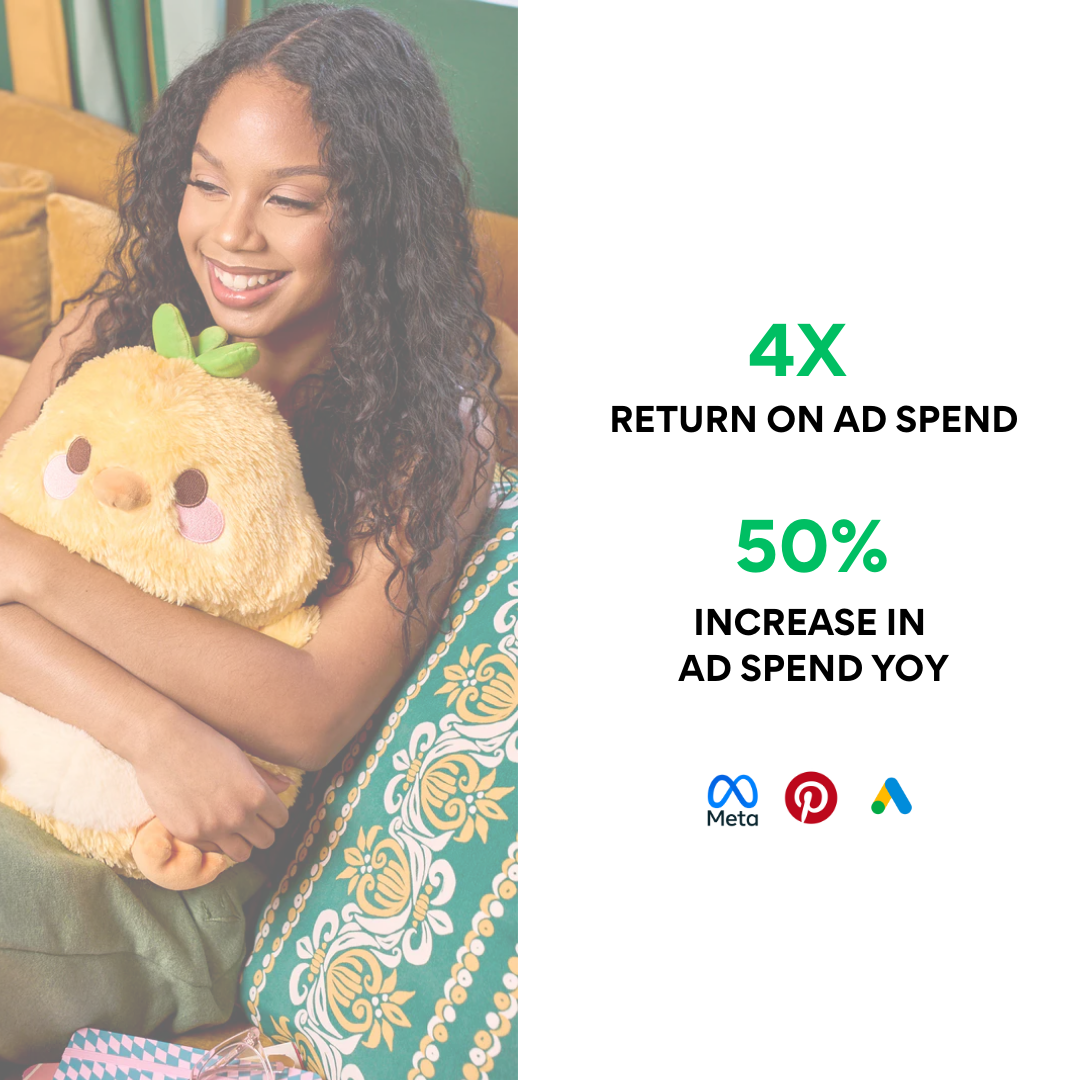
4.53x
Average ROAS — up from 3x baseline
$17,639 spend · 1,214 purchases · $14.63 CPA · 17,167 adds to cart across 5 active campaigns
Pinterest
6.8x
Net ROAS over 3 months
$7,341 spend · $49,095 total order value · $8.68 CPA · 2.3M impressions · launched from zero
Across both channels, the brand generated over $66,000 in tracked purchase value on roughly $25,000 in combined ad spend — a blended 2.6x return at the account level, with Pinterest delivering nearly double the ROAS of Meta on a lower spend base.
Platforms
Meta Ads
Pinterest Ads
Frequently asked questions
How do you improve ROAS on Meta for a DTC brand stuck at 3x?
The most common cause of a 3x plateau is a single campaign structure serving a multi-category catalog. Different product sub-categories have different audiences, different purchase cycle lengths, and different creative requirements. Separating them into isolated campaign structures — with dedicated audience pools and ROAS benchmarks per segment — typically unlocks the next tier of performance without increasing overall spend.
Does Pinterest actually work for DTC performance advertising?
Yes, for the right product categories. Pinterest users are in a discovery and planning mindset — they arrive with purchase intent, not just scroll intent. Women's lifestyle, accessories, and home goods consistently outperform expectations on Pinterest because the platform captures buyers earlier in their decision cycle. This brand achieved $8.68 CPA on Pinterest versus $14.63 on Meta — with a 6.8x net ROAS over three months.
How long does it take to see results from Pinterest ads?
Expect a 4–6 week learning and testing period before scaling spend on Pinterest. The platform's auction and audience signals are different from Meta, and the winning targeting approach varies by catalog. We run structured tests at low spend before scaling — the first month is data collection, month two is performance.
How do you compete against lower-priced alternatives in paid social?
Stop trying to explain quality in copy and start showing it visually. The creative brief is: make the quality difference obvious in the first frame. Materials shown in context, product detail shots, in-use lifestyle imagery that cheap alternatives can't replicate. Price-focused competitors are competing on one axis. Quality-first creative creates a different category entirely in the viewer's mind.
Competing on quality, not price?
We'll audit your current paid social setup and show you exactly where the next ROAS opportunity is. Free.
Get a free audit